HSE 73-2901 Thermostatic Moist Chamber Type 834/8
Introduction:
The Temperature Controlled Moist Chamber Type 834/8 with metal tube heat exchanger is intended for use in ex-vivo perfusion studies on abdominal isolated organs of small experimental animals, such as kidney, liver, spleen or mesenteric bed of mice, rats or guinea pigs. Hearts can also be perfused in horizontal position e.g. for imaging. The chamber has been designed to perfuse the above-mentioned isolated organs under best physiological temperature conditions.
The organs in the chamber can be perfused under constant pressure or constant flow. The thermostatic Moist Chamber Type 834/8 can be used in combination with HSE perfusion equipment (pumps, reservoirs, oxygenators, filters etc.) and the HSE PLUGSYS measurement system with the SCP pressure regulator to provide constant pressure perfusion and calculate the flowrate of the organs.
Items Needed:
In order to work with the moist chamber, it is necessary to have the following additional items:
- A thermocirculator, capacity approx. 3 - 5 litre, distilled water and algal growth inhibitor, e.g. Thermoclean DC.
- A Carbogen source for aeration. Either a central supply or a Carbogen cylinder with a pressure regulator. If additional gas mixtures are to be used, the appropriate connections or cylinders have to be provided.
- A reservoir for the perfusate, with a gas frit for aeration. The quantity of perfusate depends on the requirement of the intended experiment.
- In case of foaming perfusion hollow fiber oxygenators can be used.
- A pump, usually a peristaltic pump (for blood we also can offer small centrifugal pumps), with the required output, adjustable in speed up to 30 ml/min.
- An adapted cannulae set
Additionally we recommend for more accurate measurements and control of the perfusion pressure:
- A pressure transducer for measuring the perfusion pressure, e.g. an APT-300 or P75 transducer
- A bridge amplifier (e.g. HSE TAM-A or TAM-D) to amplify the signal and to make it suitable for a computerized signal data acquisition and evaluation system (e.g. HSE BDAS Software).
- A TAM-D Transducer Amplifier Module and an SCP controller module to perform constant flow or constant pressure perfusion with calculating the flowrate in ml/min from the pump speed.
Measurement of additional parameters (e.g. perfusion flow measured with an ultrasound transit time flowmeter) may be useful depending on the particular application involved in the experiment. The necessary measuring equipment must then be added to the complete apparatus. In general all is modular and a system can grow with the application and needs.
Description:
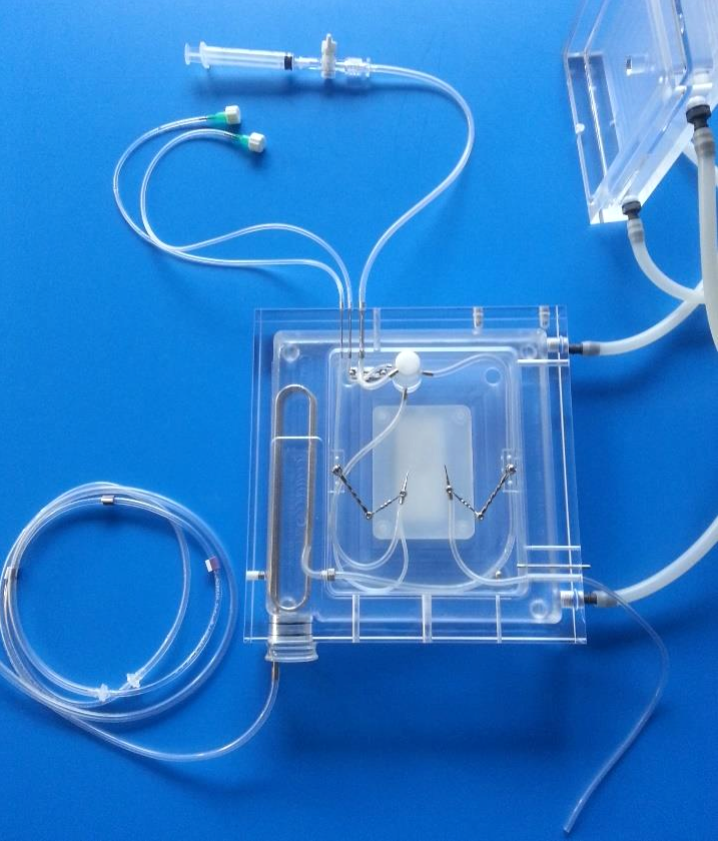
The moist chamber consists of the bottom (the actual chamber) and the removeable cover. Both bottom and cover are jacketed and thermostated with warm water passing through them. Operation of the moist chamber therefore requires a laboratory thermostat with built-in pump.
The moist chamber is equipped with a metal heat exchanger to warm the perfusate and compensate the heart loss between reservoir and organ. The perfusate is warmed in the heat exchanger and then passes directly into the interior of the chamber. Thus, it cannot cool down. Therefore, the perfusate temperature corresponds exactly to the water temperature.
To enable the fixation of organs a silicone pad is fitted onto the bottom of the interior chamber. The silicone pad can be removed e.g. for cleaning the chamber. Inside the moist chamber there are two Plexiglass strips on both sides, each with four threaded holes (M2). These holes are provided so that 5 mm dia. balls can be screwed into them. The balls take the clip-on segments of the mini ball joint holders. The mini ball joint holders are used to ensure that the connecting cannulas (also fitted with suitable balls) for the perfused organ are held in the required position. They can also secure other devices such as electrodes, tubing or catheters.
A number of apertures and stainless steel tubes are provided in the chamber walls; they can be used for:
- Supply and discharge of perfusate
- Connection of measuring probes (e.g. pressure transducer)
- Discharge of bile (liver perfusion)
- Discharge of urine (kidney perfusion)
- Infusion of drug
Under constant flow condition the moist chamber is used together with a roller pump supplying the required flow rate. The perfusate equilibrated with gas (O2 / CO2) is drawn by the pump from a reservoir. If constant pressure perfusion is required, the pressure will be measured with an APT-300 or a P75 pressure transducer, connected to a TAM-D module and an SCP controller module. The SCP controller will regulate the pump speed with a build in PID regulator to keep the pressure constant.
On the SCP module you can set the wished pressure (SET POINT). As the SCP knows the pump speed it also calculates the flow in ml/min.
Figure 1 shows an overview of the moist chamber.
1. Jacketed lid of the moist chamber
2. Holder for bubble trap (option). The bubble trap is plugged onto this holder.
3. Ports through the walls of the moist chamber, for use as required (e.g. for connecting a pressure transducer APT-300 or P75).
4. Bottom of the moist chamber. The bottom is jacketed. The inner of the chamber has to be equipped with cannulae to perfuse the isolated organ. To avoid dehydration of the isolated organ the bottom of the moist chamber has to be filled with a small amount of perfusion solution.
5. Heat exchanger of the moist chamber. Warm water from the thermostating circuit passes around the stainless-steel tube. The perfusate is pumped through this tube and effectively warmed. The passage through the chamber must be water-tight to ensure that no water from the thermostatic circuit passes into the chamber.
6. Tubing for perfusate supply from reservoir via roller pump to heat exchanger.
7. Silicone pad on which the organ is mounted. Organ can be fixed in position by inserting needles. The silicone panel is removable e.g. for cleaning the chamber.
8. Perspex strip with four threaded holes (M2) for securing the mini joint ball holders.
9. Tubing from heat exchanger (5) for bubble trap (73-3692) or cannula.
10a, 11a. Tubing from thermocirculator.
10b, 11b. Tubing to the thermocirculator
12. Bubble trap
13. 3ml syringe with stopcock to adjust air cushion in bubble trap
14. Tube for drug addition
15. Tube to measure perfusion pressure in arterial cannula
16. arterial cannula
17. venous cannula
18. venous outlet
General Notes:
The organ to be perfused ex-vivo is placed into the chamber at a suitable position on the silicone plate and if necessary fixed with needles. In general, a gaze layer can be is placed on the silicone plate or the silicone pad can be completely replaced by a gaze cushion.
Thermostating:
Connect the inlet and the outlet port of the cover and the bottom chamber to a thermocirculator. Ensure that bottom and cover are filled with warm water (37°C) bubble free.
Organ connection:
Immediately before mounting the organ ensure that the entire perfusion system up to the distal end of the perfusion cannula is filled with fresh perfusate and free from air bubbles. Arrange the organ connection canulae so that the vessels are not kinked and the perfusate can flow easily. The mini ball joint holders with the cannula are useful here.
The canulae are equipped with a basket like tip which allows easy insertion into the vessels and avoids any occlusion of the vessel during preparation and experiment.
Perfusion pressure:
During perfusion ensure that the pressure acting at the organ does not exceed the physiological perfusion pressure specific for this organ. This is only possible by using a suitable pressure measuring system (e.g. pressure transducer APT-300 or P75 with HSE amplifier module TAM-A or TAM-D). In order that the true pressure is being measured it is necessary to connect the pressure transducer as close as possible to the organ. To measure the pressures best is to use cannulae with side port.
Chamber Environment:
After the chamber has been closed with the cover it takes a few minutes until the desired temperature and humidity are reached in the chamber. In order to saturate the air in the chamber with water vapour it is necessary to have sufficient water in the chamber. Always ensure that a little water or perfusate is on the bottom of the chamber. In an organ the surface of which has previously been moistened, dries quickly inside the closed chamber, this is a sure sign that there isn`t any liquid inside the chamber.
If possible do not open the chamber during operation. After it has been closed it takes some time for the warm, moist environment to become established again.
Bubble Trap:
Watch the filling level of the bubble trap! Always fill it before starting the experiment to around ¾ with fluid.
Recirculating Operation:
When operating with recirculation it is possible that tissue particles flushed out of the organ can reach the perfusate. In order to avoid micro embolism in the organ during perfusion it may be necessary to insert a particulate filter of 40 to 80 µm into the perfusion circuit, e.g. before the heat exchanger. Always install the filter after the pump, never on the suction side.
Comments
0 comments
Please sign in to leave a comment.